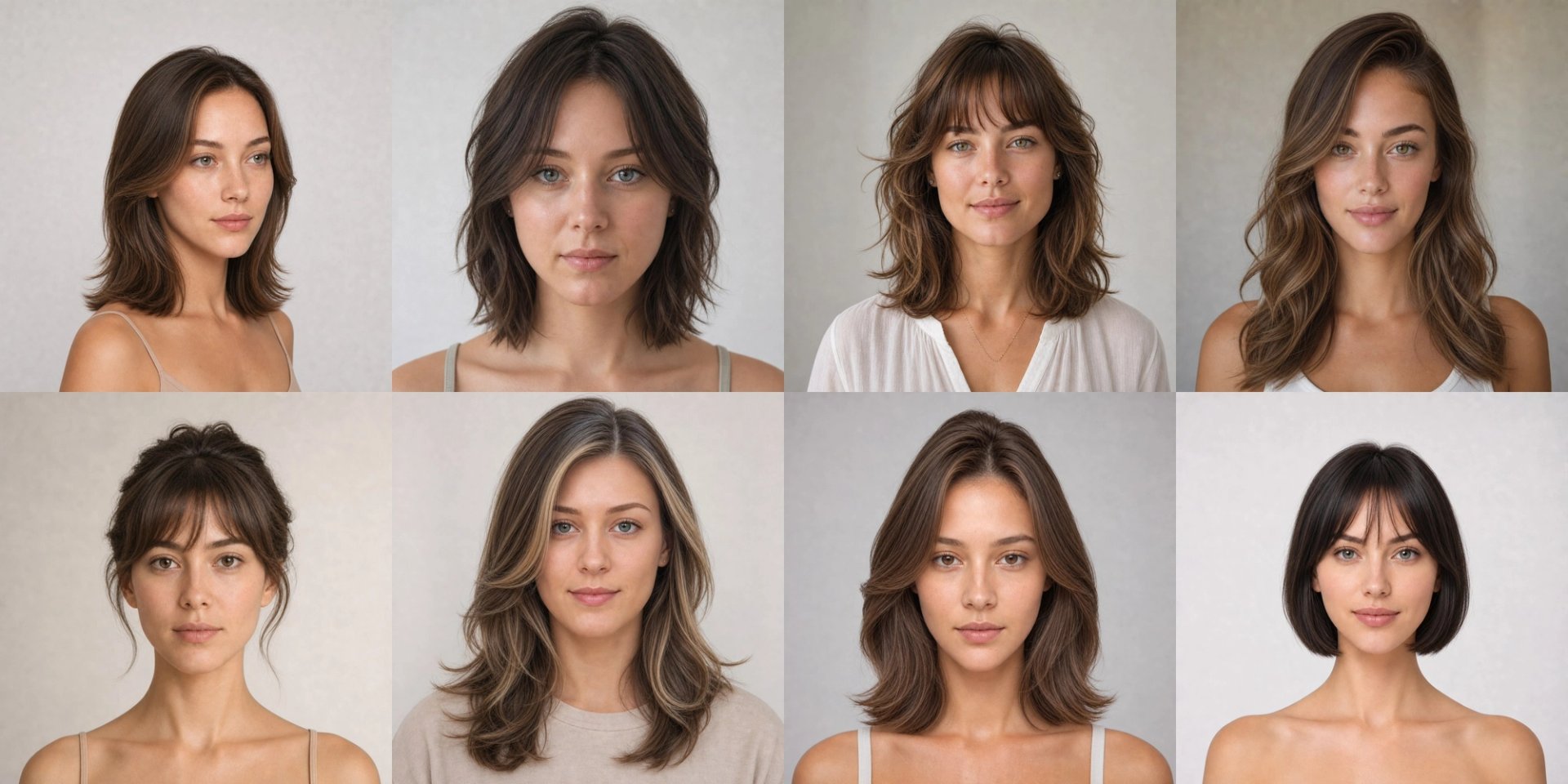
Best Bangs for Every Face Shape
Not every bangs style works on every face. See which fringe shape suits your face shape, from curtain to blunt to side-swept, and which ones to skip.
STYLEFINDEN editorial review: checked before publication for wearability, proportion logic and real-life outfit use. We explain our editorial method and image policy on the About page and keep affiliate independence details in the affiliate disclosure.
Bangs are one of the highest-impact changes you can make to a hairstyle, and also one of the easiest to get wrong for your face shape. Before choosing a fringe, it helps to know your face shape — our face shape guide covers that in a couple of minutes — and to understand how bangs interact with the rest of your cut, which we cover in more depth in our hairstyle guide. This guide breaks down which bang styles work best for each face shape, and which ones tend to fight against your features instead of working with them.
The General Rule: Bangs Should Balance, Not Repeat
The most useful way to think about bangs is what they add to the shape of your face, since a fringe sits right at the top and directly changes how wide or long the face appears to be. A straight line repeats an already-present straight line — like a square jaw — and makes it more obvious. A curved or broken line softens a straight feature. The goal is almost always to add whatever's missing: width where the face is narrow, softness where it's angular, or length where it's short.
Curtain Bangs
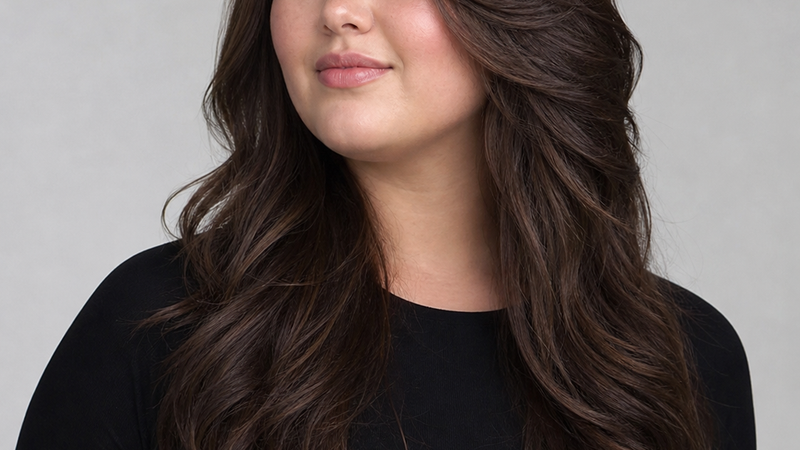
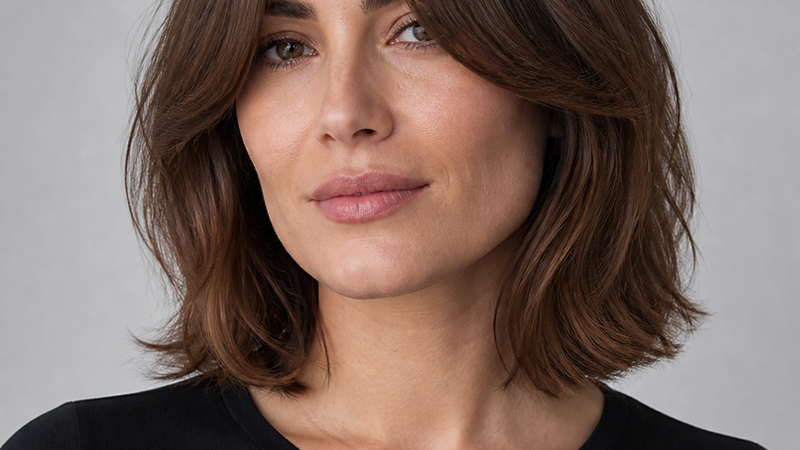
Curtain bangs part in the middle and sweep to both sides, framing the face rather than covering the forehead. They're the most broadly flattering bang style because they work with almost every face shape — they soften square jaws, balance heart-shaped foreheads, and add gentle framing to round and oval faces without adding bulk. If you're unsure where to start, curtain bangs are the lowest-risk option.
Side-Swept Bangs
Side-swept bangs run diagonally across the forehead instead of straight across. They work particularly well for heart-shaped and diamond faces, where a diagonal line softens a wide forehead more than a straight one would. They also suit rectangle faces by breaking up forehead length without adding the width a full fringe would.
Wispy Bangs
Wispy bangs are thin, textured, and slightly uneven rather than a solid block of hair. Because they're light and broken up, they work well on round faces, where a heavy full fringe can add unwanted width low on the face. They're also a good option if you want the effect of bangs without a dramatic change, since wispy bangs blend more easily into the rest of the hair.
Full, Blunt Bangs
A full, blunt fringe cut straight across is the boldest bang style, and it's also the most face-shape-specific. It works well on oval faces, which have the length to spare, and on rectangle faces, where the straight horizontal line visually shortens the face. On square or round faces, a full blunt fringe tends to repeat an already-present width or add a second straight line to an angular face, which can make the shape more obvious rather than balancing it.
Bottleneck Bangs
Bottleneck bangs part in the center and stay close to the face on both sides, narrower than curtain bangs. They work best on oval and round faces, where the close-to-face framing adds a bit of definition without adding width. On heart-shaped or diamond faces, the narrow center part can draw more attention to a wide forehead, so a wider curtain style usually works better there.
Micro Bangs
Micro bangs sit high above the eyebrows and expose most of the forehead. They're the most dramatic option and work best on oval and rectangle faces, where there's enough forehead length to support a short fringe without feeling crowded. On round, square, or heart-shaped faces, micro bangs tend to expose width at the forehead that other bang styles are specifically designed to soften — they're not off-limits, but they need to be a deliberate choice rather than a default.
Face Shape Matrix
Oval faces (see our oval face guide) can wear nearly any bang style, including full, blunt, and micro bangs, since there's little correction needed.
Round faces (see our round face guide) generally do better with wispy or bottleneck bangs, which add definition without adding width low on the face.
Square faces (see our square face guide) tend to suit curtain bangs best, since the center part and soft sweep avoid adding another straight line to an already-angular face.
Heart-shaped faces (see our heart-shaped face guide) generally do best with side-swept or curtain bangs, both of which soften a wider forehead diagonally rather than covering it evenly.
Diamond faces (see our diamond face guide) pair well with side-swept bangs, which soften the narrower forehead point without adding bulk at the widest part of the face, the cheekbones.
Rectangle faces (see our rectangle face guide) generally benefit most from full, blunt bangs or micro bangs, since a strong horizontal line visually shortens a long forehead.
Triangle faces (see our triangle face guide) tend to suit curtain or side-swept bangs, which add softness and a bit of visual width near a narrower forehead without disrupting the balance lower down.
Bangs and Hair Texture
Face shape isn't the only factor — hair texture changes how a bang style behaves day to day. Curly or wavy hair tends to shrink upward as it dries, so a fringe that looks full and blunt when wet can end up shorter and more textured once dry; many curly-haired people size up slightly or choose curtain or wispy styles that work with natural shrinkage instead of against it. Fine, straight hair holds a blunt line cleanly but can look flat without regular styling. Thick hair can carry a heavier, fuller fringe without looking sparse, while fine hair often reads better with a wispier, lower-density cut.
Bangs and Glasses
If you wear glasses, keep in mind that the top of the frame and the bottom of the bangs will interact. Bangs that sit too low can crowd heavy or thick frames, while lighter, rimless frames have more room to work with a fuller fringe. For more on frame shapes by face type, see our glasses guide.
FAQ
What bangs are the most universally flattering?
Curtain bangs are the safest choice across almost every face shape, since the center part and side sweep add gentle framing without repeating any one feature.
Do bangs suit a round face?
Yes, but wispy or bottleneck styles tend to work better than a full, blunt fringe, which can add extra width low on an already-round face.
Should I get bangs if I have curly hair?
You can, but expect curly bangs to shrink shorter once dry. Curtain or wispy styles tend to work better with natural curl shrinkage than a blunt, full fringe cut to an exact length.
Can bangs make a long face look shorter?
Yes — a full, blunt fringe or micro bangs are the most effective at this, since the strong horizontal line visually breaks up forehead length.
Weekly outfit picks and style guides — no fluff, unsubscribe anytime.