Old Money vs. Quiet Luxury: What's Actually Different?
Old money and quiet luxury get used as synonyms, but they're not the same aesthetic. Here's the real difference — and why it matters for how you shop.
STYLEFINDEN editorial review: checked before publication for wearability, proportion logic and real-life outfit use. We explain our editorial method and image policy on the About page and keep affiliate independence details in the affiliate disclosure.
People use "old money" and "quiet luxury" interchangeably, and the fashion industry has done nothing to correct that. Both trended at the same time. Both got attached to the same Pinterest boards, the same Succession-adjacent moodboards, the same beige. But they didn't come from the same place, and they don't solve the same problem for the person wearing them.
Old money is a costume with a backstory — it's dressing like you inherited the wardrobe along with the house. Quiet luxury is a costume with no backstory at all — it's dressing like you don't need one. If you want the full breakdown of the old money aesthetic on its own terms, our complete guide to old money style covers it in depth. Here, the question is narrower but just as useful: what actually separates it from quiet luxury, and why does the difference change how you shop?
What Is the Old Money Aesthetic?
Old money style dresses toward heritage — East Coast prep schools, English country estates, tennis club dress codes from a period before dress codes needed enforcing. Think tailored trousers, cable-knit polos, riding boots, crested blazers. The clothes reference a specific social world: New England boarding schools in the 1960s, Ralph Lauren's entire brand mythology built in the 1970s and 80s, the Kennedy family's East Hampton summers. It's aspirational nostalgia for a lifestyle most people wearing it never lived.
What Is Quiet Luxury?
Quiet luxury has no era attached to it at all — that's the point. It's a 2020s response to logo-driven fashion and the fatigue of a decade of Instagram flexing. The aesthetic says: I have money, and I have nothing to prove about it. No monograms, no visible branding, no obvious signaling. Just fabric quality, exact fit, and a color palette so restrained it borders on absent. Where old money borrows a costume from the past, quiet luxury refuses to look like a costume at all.
Where the Two Aesthetics Actually Overlap
Both reject the maximalism of 2010s influencer dressing — the logo belts, the bold branding, the outfit-as-billboard approach. Both lean on tailoring over trend pieces, on wide-leg trousers over anything cropped-and-clingy, on neutral palettes over saturated color. Both photograph well in soft, flattering light and terribly under a ring light next to a haul video. If you pulled ten random pieces from each wardrobe and mixed them, most people couldn't sort them back into two piles with total confidence — and that's exactly why the confusion exists.
The Real Differences: Silhouette, Fabric, and Color Logic
Silhouette is the clearest tell. Old money uses structured, decade-specific shapes — the polo collar, the pleated tennis skirt, the equestrian boot, the crested blazer. Quiet luxury flattens all of that into a single silhouette family: relaxed tailoring, minimal seaming, almost no ornamentation. An old money blazer has a story built into its cut. A quiet luxury blazer is engineered to disappear into the room.
Fabric tells a second story. Old money allows texture as decoration — cable-knits, plaid wool, corduroy, tweed. These fabrics have visible character; you can identify them from across a room. Quiet luxury treats fabric as the entire argument: the cashmere has to be good enough that the garment needs zero other detail to justify its price. Take the texture away from an old money sweater and you've lost the outfit. Take the texture away from a quiet luxury sweater and nothing changes, because there wasn't texture doing the work in the first place — drape and fit were always the point.
Color logic is the third divide, and it's the one people miss most often. Old money uses a defined palette — navy, burgundy, hunter green, camel, cream — that reads as heritage color, tied to school crests and country-club uniforms. Quiet luxury narrows further into near-monochrome: black, white, ivory, gray, taupe, with almost no saturated color at all. The common assumption is that quiet luxury is just old money with the color turned down. That's backwards. Quiet luxury removes color specifically because color is a form of personality signaling, and the entire aesthetic is built around removing signals, not softening them.
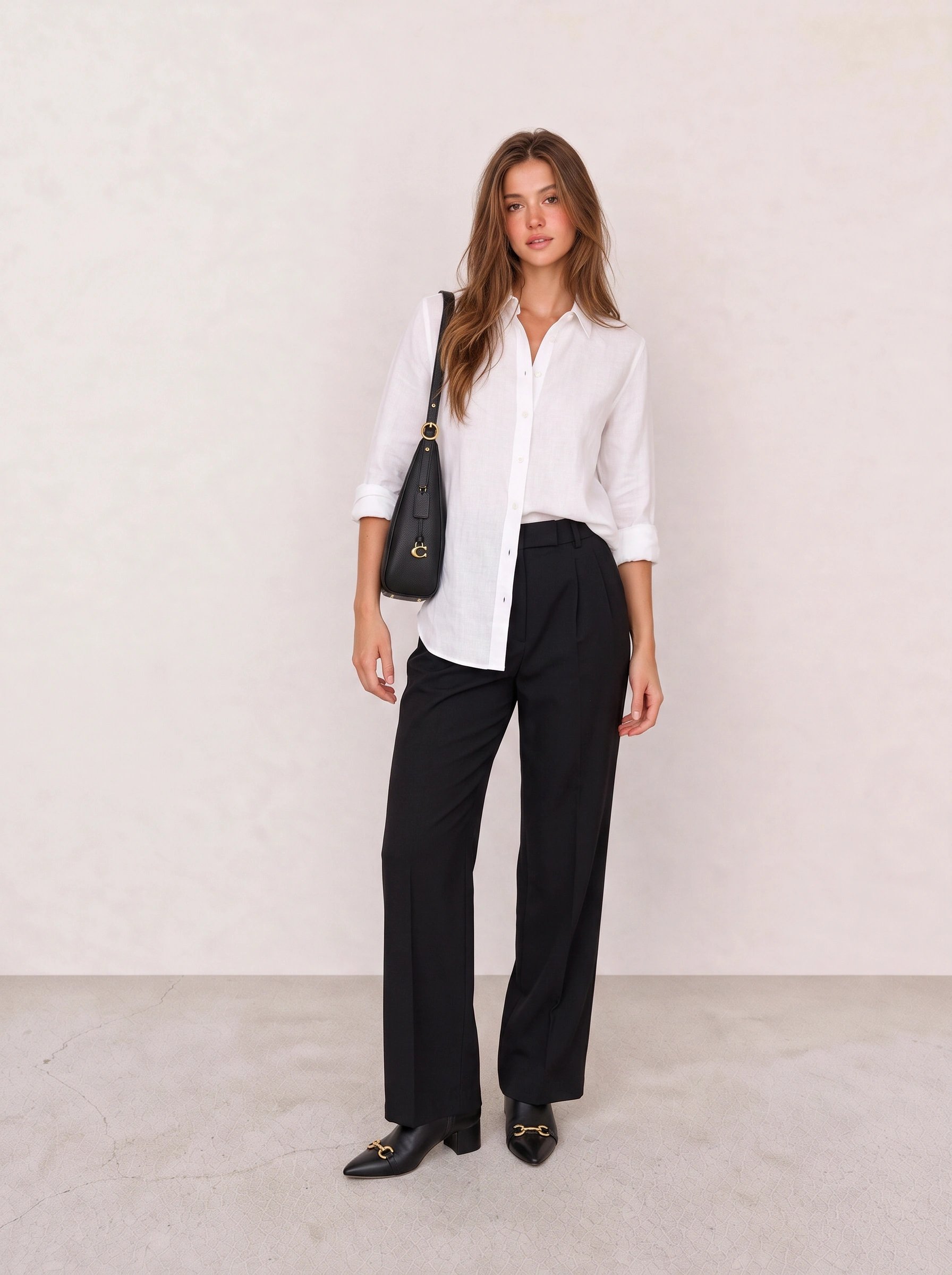
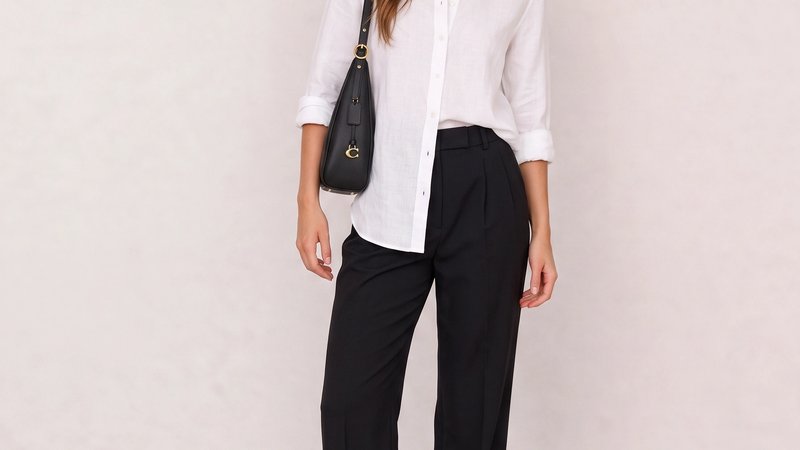
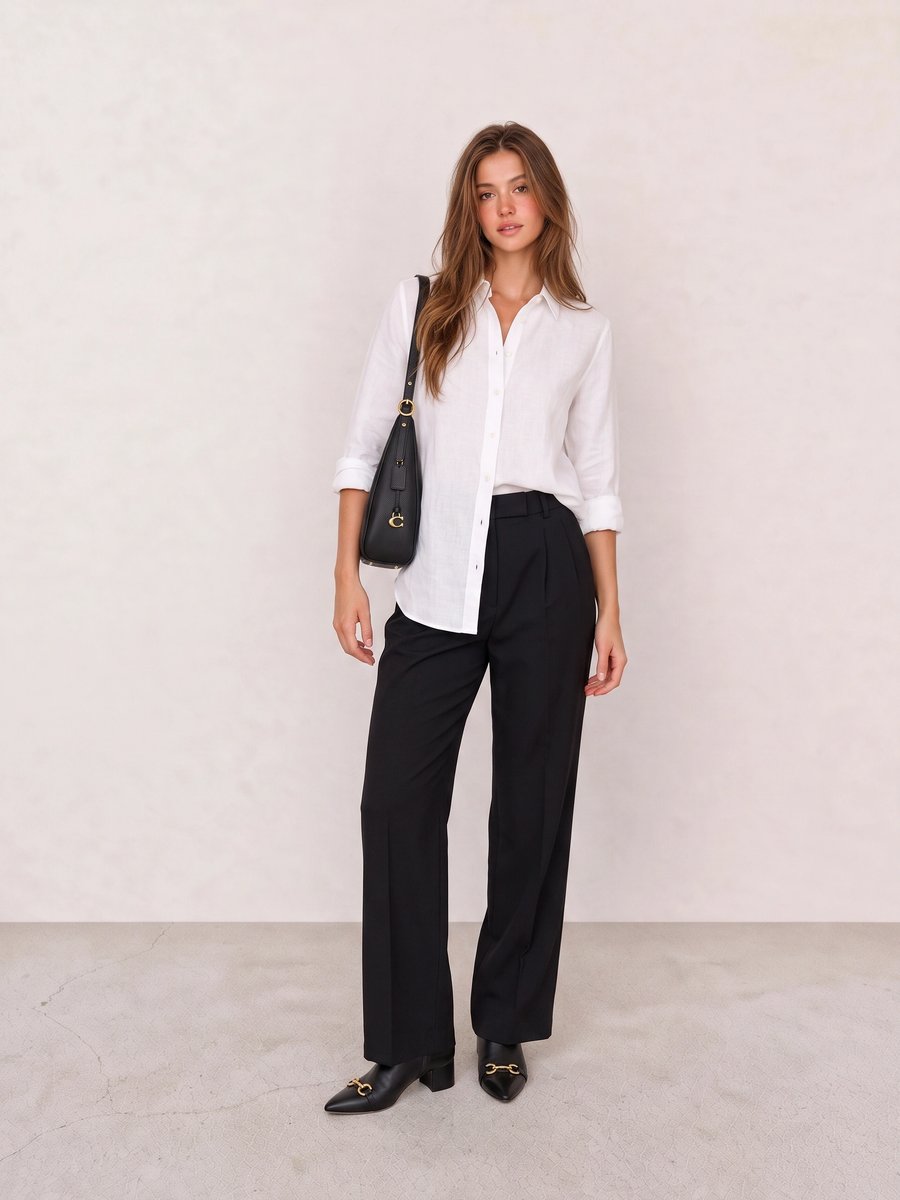
The color logic shows up clearly in the White Button-Down Shirt & Black Tailored Trousers, which reads as old money rather than quiet luxury because of the mechanism, not the color count. The gold-bit detail on the ankle boots is the signal — a hardware reference to equestrian tack, which is exactly the kind of heritage decoration quiet luxury strips out entirely.
Without that bit hardware, this outfit collapses into generic minimalism — it would read as quiet luxury, or just as "business casual," losing the specific heritage reference that makes it old money in the first place. The formula: a crisp white shirt, black tailored trousers, and one piece of equestrian-coded hardware. That third element is doing more work than the other two combined.
A common mistake: people think swapping in cheaper basics automatically reads as quiet luxury because the silhouette looks the same in a thumbnail. It doesn't. Quiet luxury is unusually unforgiving of bad fabric up close — a poly-blend trouser in the exact right cut still reads as fast fashion the moment someone stands near it. Old money hides fabric quality issues better because texture and pattern do some of the distraction work.
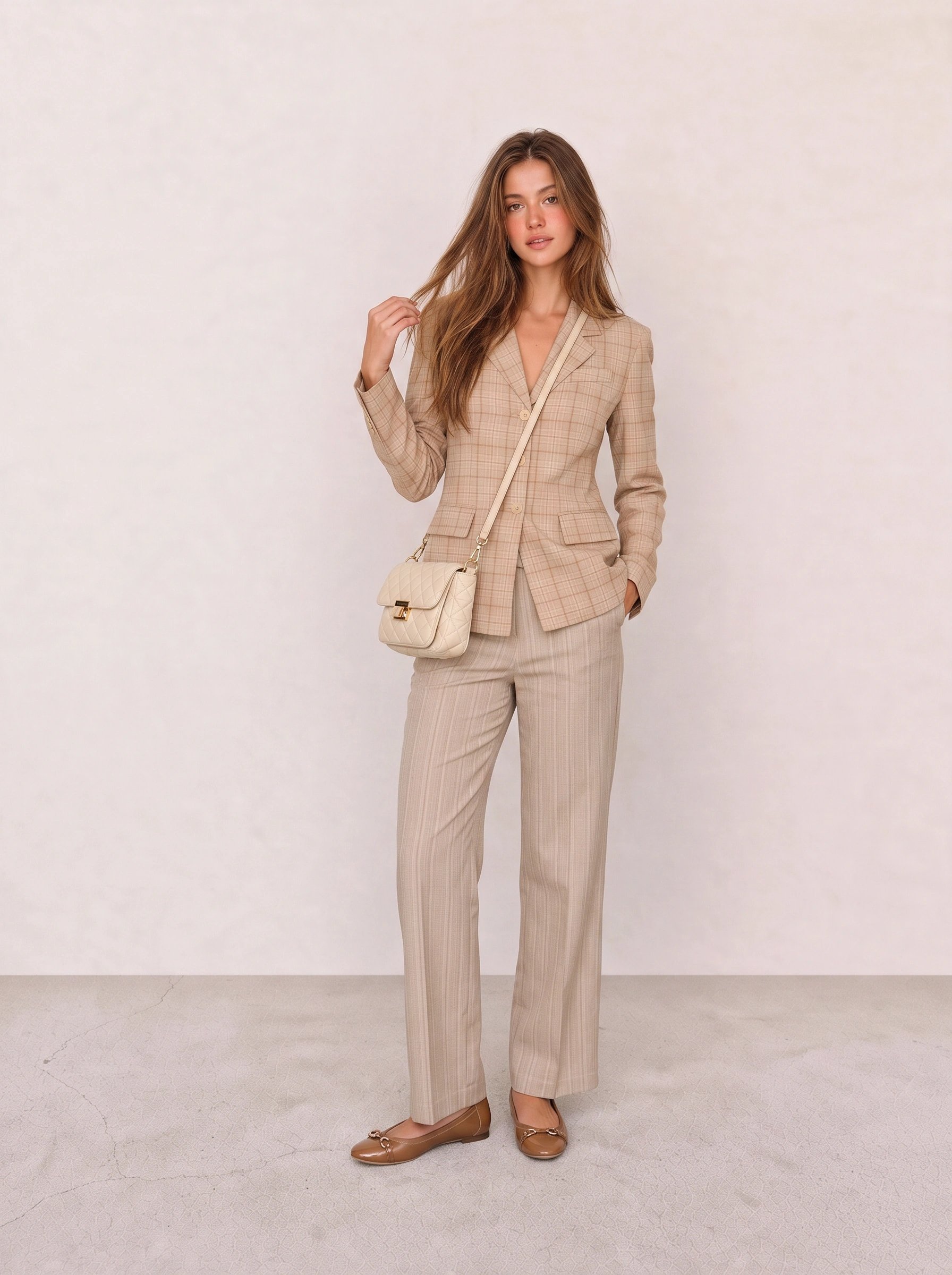
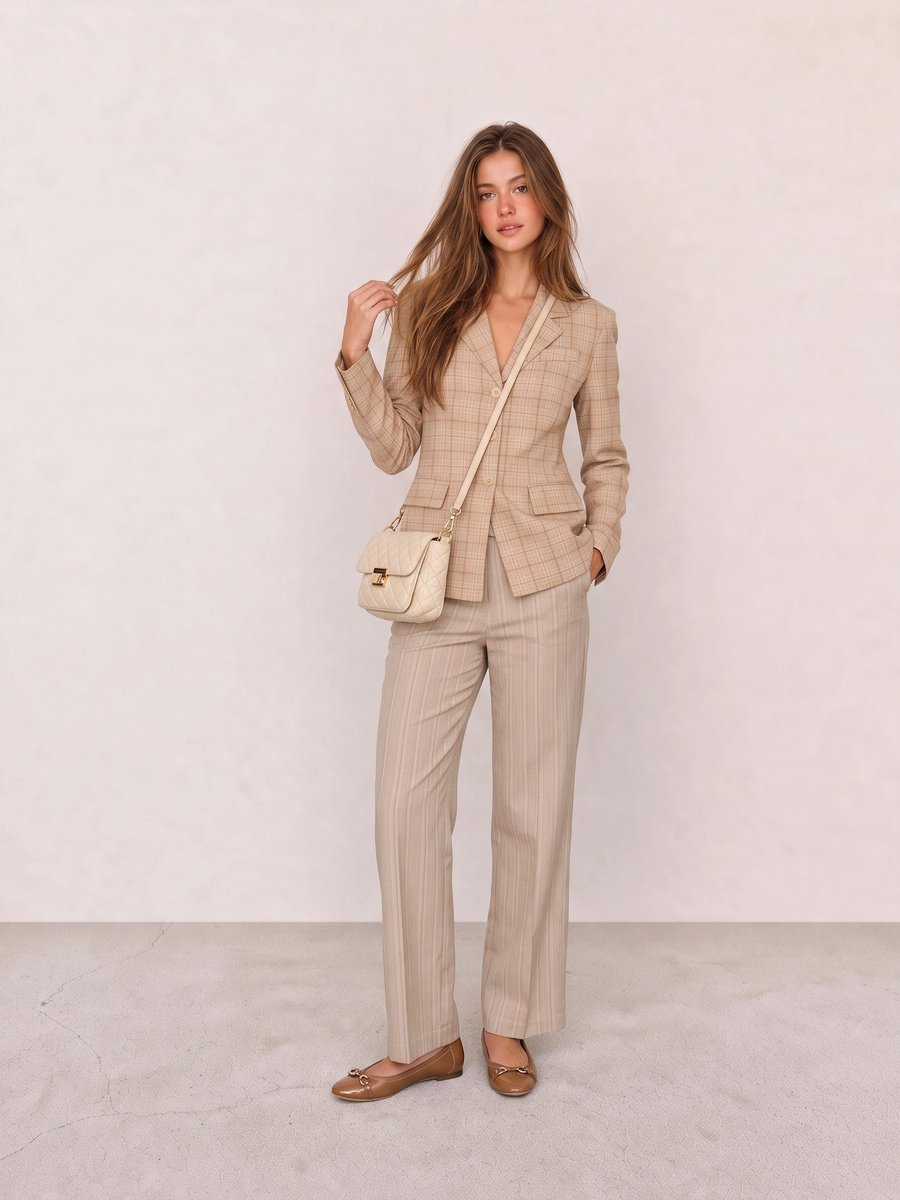
Fabric pattern is the mechanism worth naming in the Beige Plaid Tailored Blazer & Beige Pinstripe Wide-Leg Trousers. Two different patterns — plaid on top, pinstripe below — sit in the same tonal family, which keeps the outfit from reading as mismatched while still giving it visible texture from ten feet away.
This is where old money and quiet luxury genuinely split. A quiet luxury version of this outfit would strip both patterns to solid fabric — the entire appeal would shift from "look at this texture" to "look at how this drapes." Without the plaid and pinstripe, you're not looking at a toned-down old money outfit. You're looking at a different aesthetic with different rules. Pattern-mixing within one tonal family is a skill old money rewards and quiet luxury has no use for at all.
Worth noting: the two aesthetics are converging slightly for SS26, with old money borrowing quiet luxury's restraint on color while quiet luxury borrows old money's interest in visible fabric quality — lofty cashmere, real tweed, less synthetic-blend minimalism. Neither is disappearing. They're trading notes.
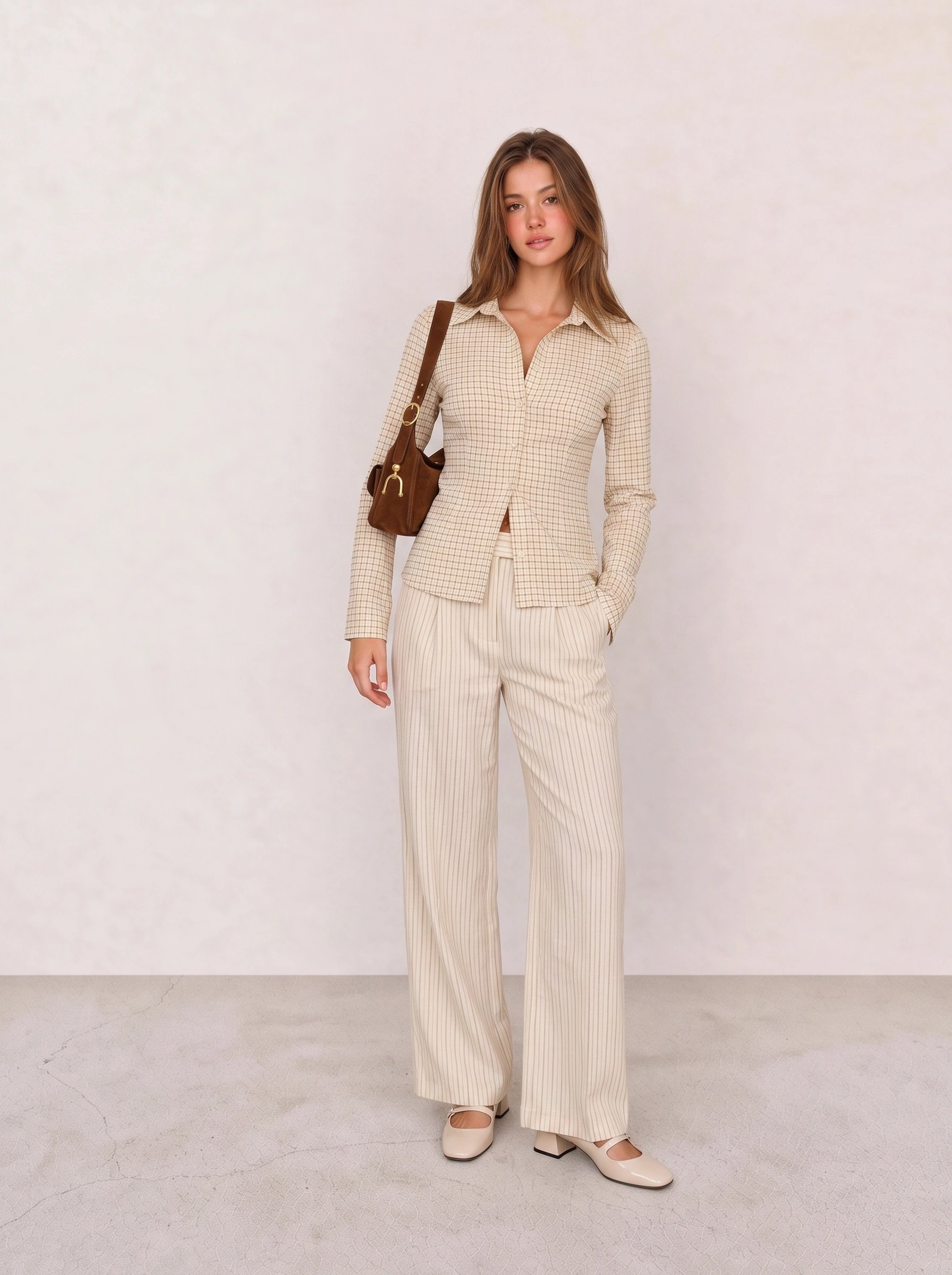
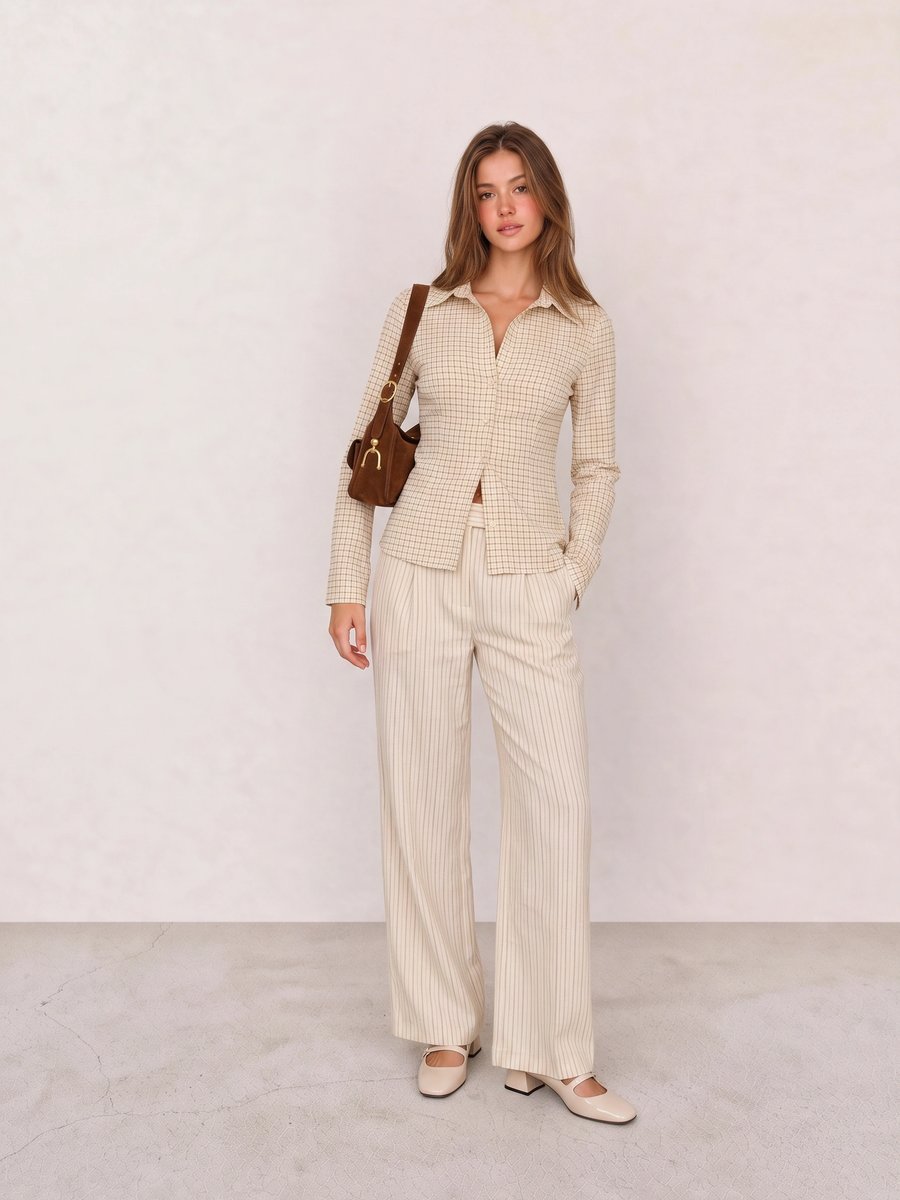
This is the outfit for a Sunday you're spending at a garden lunch that runs three hours longer than planned, and nobody's checking the time. The Cream Checked Long-Sleeve Shirt & Cream Wide-Leg Linen Trousers sits closest to the border between old money and quiet luxury of anything on this list — nearly monochrome, minimal pattern, no hardware.
What keeps it in old money territory rather than quiet luxury is the checked shirt pattern and the brown suede bag — both are heritage-coded rather than logo-free-minimal-coded. If you own one outfit to test whether you actually prefer old money or quiet luxury, start here and see which direction you want to push it: strip the check for solid cream, and you've crossed the line into quiet luxury entirely.
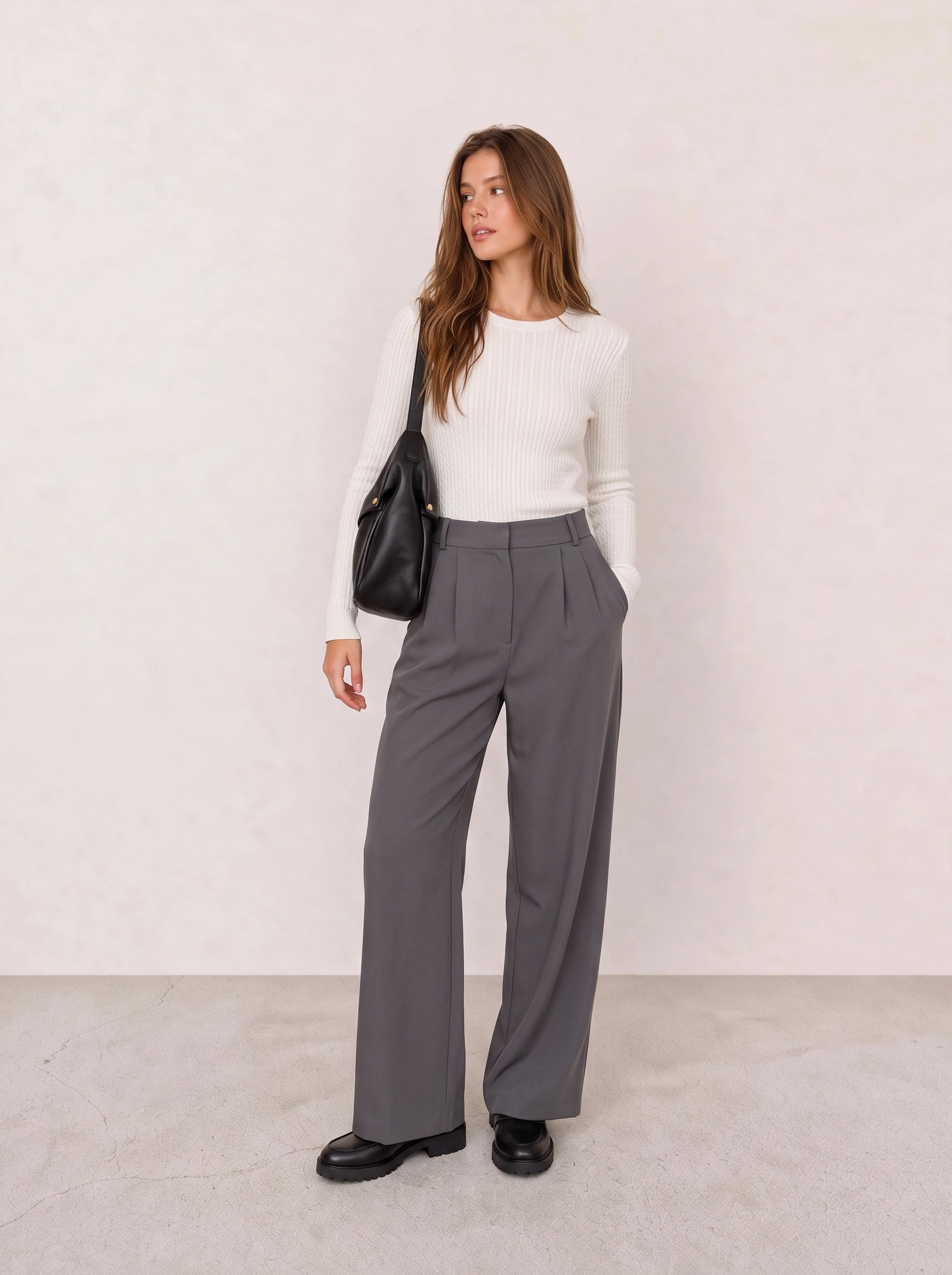
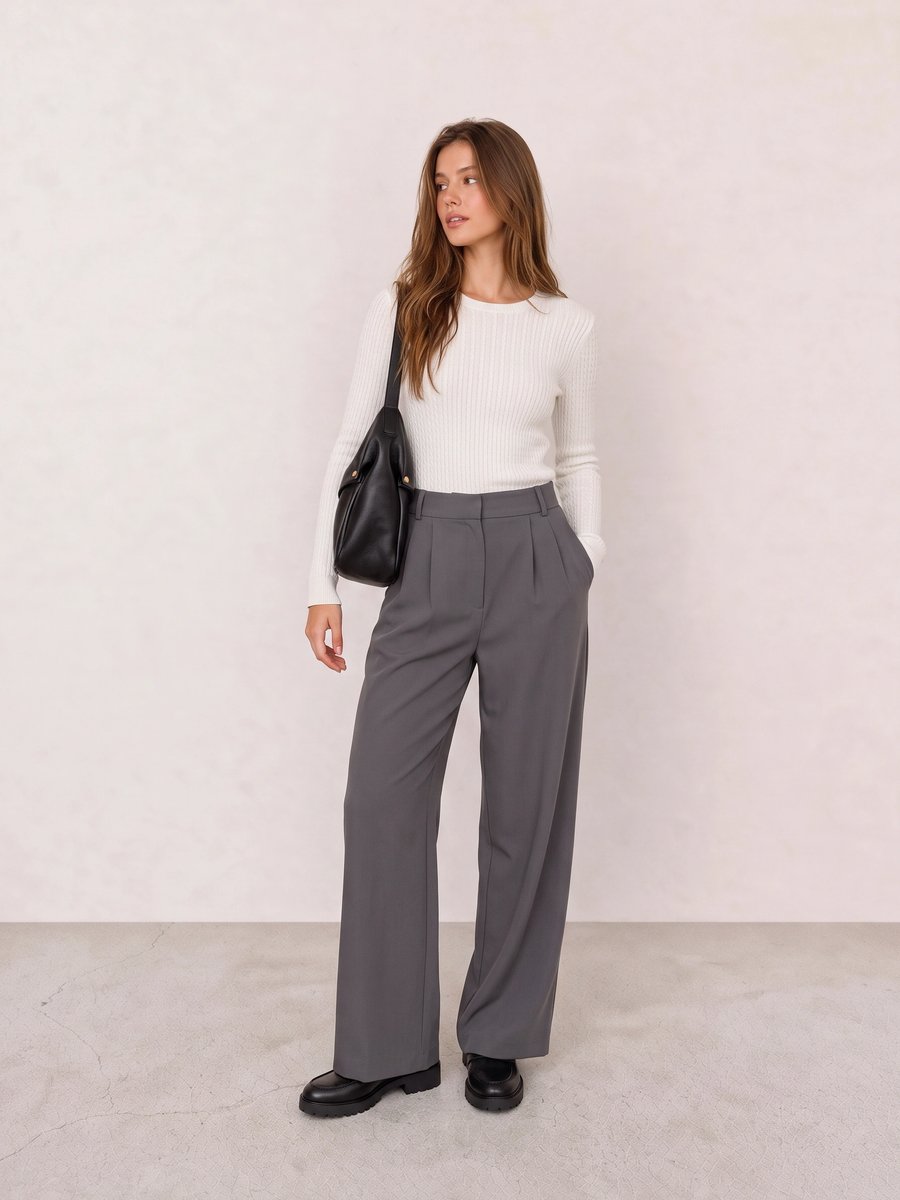
Texture carries the entire argument in the Ivory Ribbed Knit Sweater & Charcoal Wide-Leg Trousers. The rib knit catches light and creates visible dimension against the flat charcoal trouser — that contrast in surface, not in color, is what makes this outfit feel old money instead of just neutral.
Swap the ribbed knit for a smooth merino sweater in the same ivory and you've made a quiet luxury outfit — same palette, same silhouette, entirely different aesthetic family, because the surface texture was the only thing signaling heritage in the first place. Avoid this: pairing a heavily textured sweater with an equally busy trouser pattern erases the contrast that makes the texture readable at all.
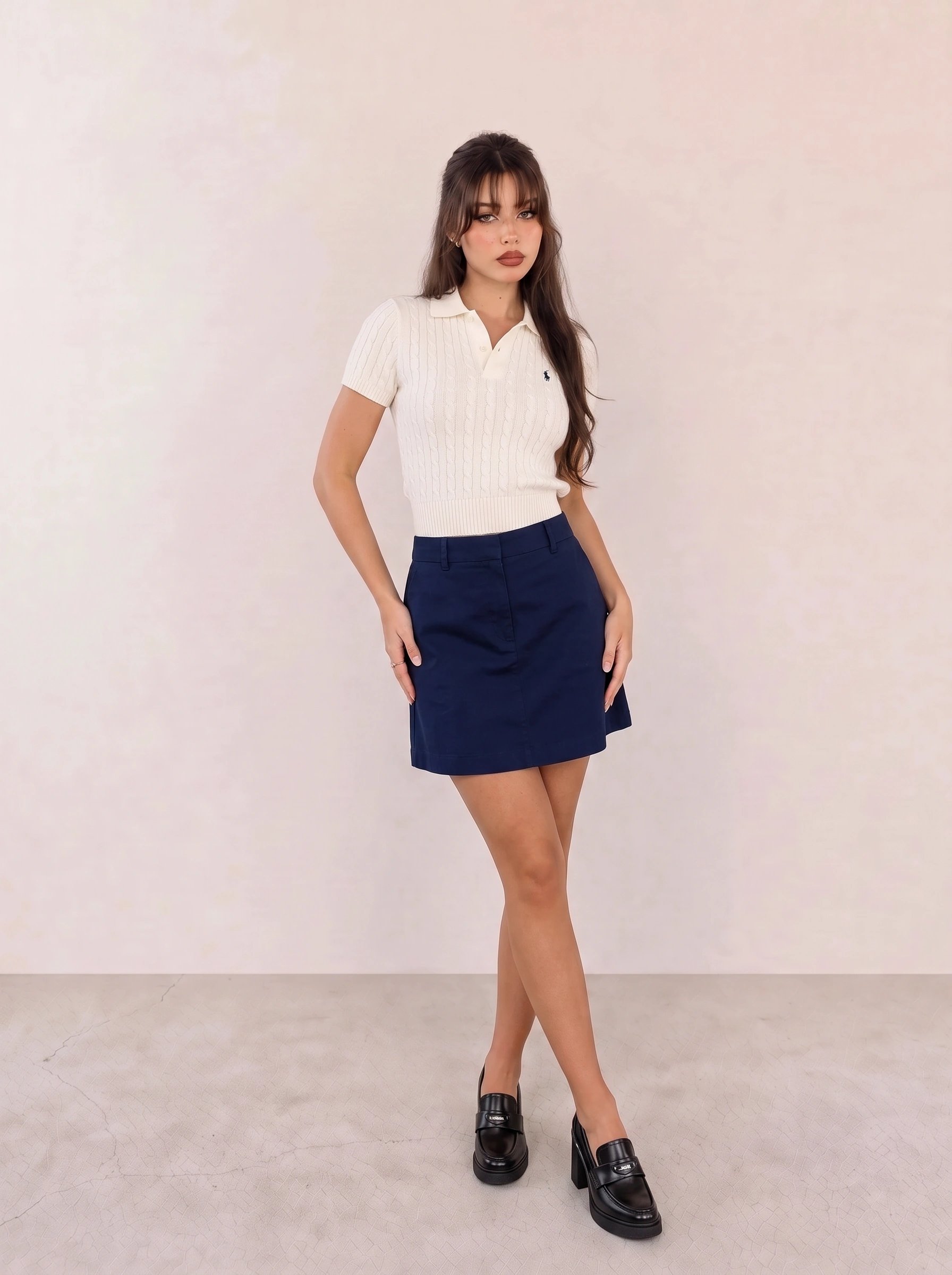
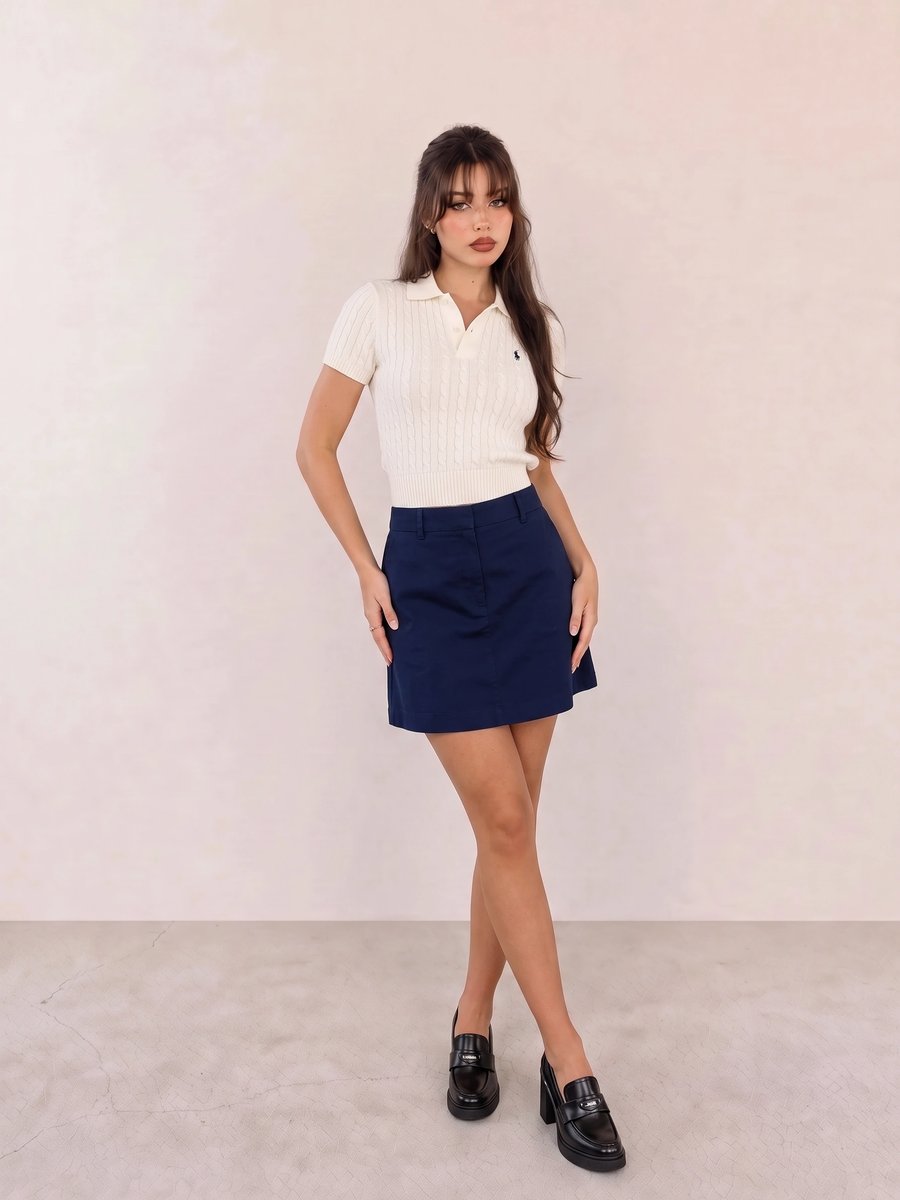
Picture this at a fall campus visit, or a weekend coffee run where you want to look put-together without looking like you tried. The Ivory Cable-Knit Polo Top & Gray Pleated Mini Skirt is the most explicitly prep-school-referencing outfit here, and it has no quiet luxury equivalent at all — the pleated skirt and polo collar are too specifically tied to a school uniform silhouette to ever read as unbranded minimalism.
This is the clearest proof that the two aesthetics aren't just different intensities of the same idea — some old money pieces have literally no quiet luxury translation, because the reference point itself (school uniform, sport-club dress code) is the entire appeal. Beginner-friendly starting point if you're new to old money: this formula requires almost no styling decisions once you own the two pieces.
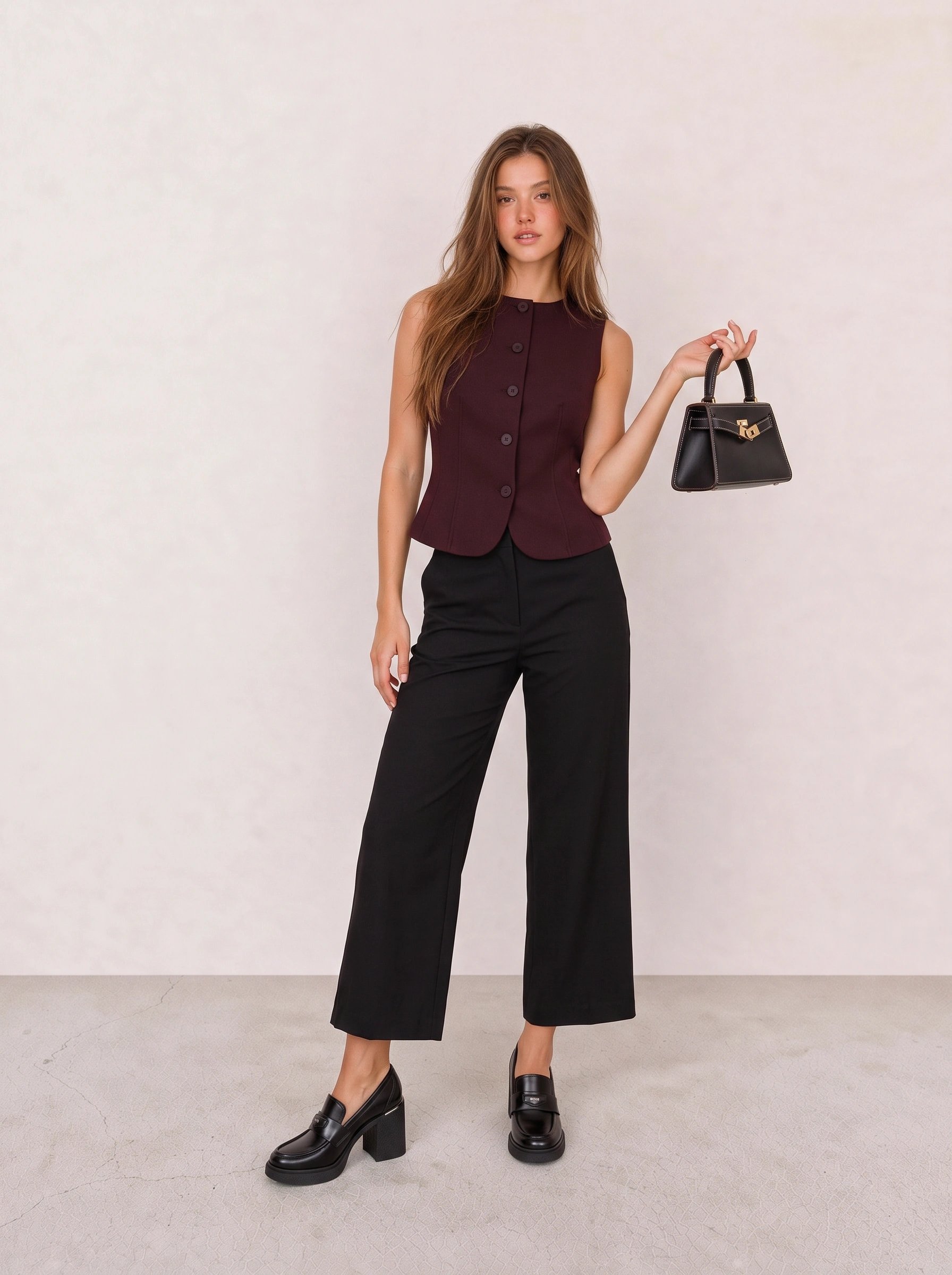
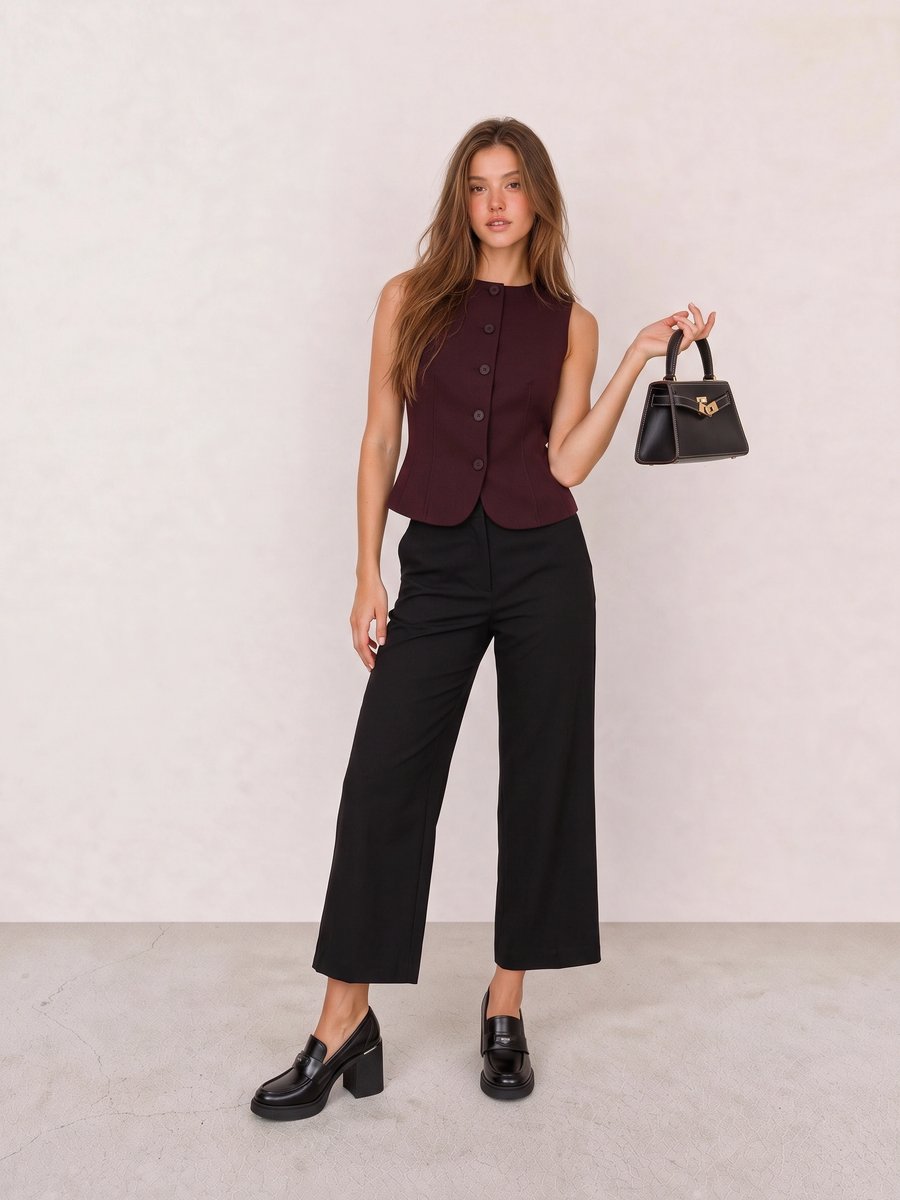
If I had to pick the single outfit on this list that quiet luxury could never absorb, it's the Burgundy Button-Front Waistcoat Top & Black Cropped Wide-Leg Trousers. Burgundy is a heritage color — hunt club, varsity letterman, oxford tie — and quiet luxury's entire color logic exists specifically to exclude colors with that kind of narrative attached.
The waistcoat silhouette adds a second layer of heritage signaling on top of the color — it's a shape borrowed from menswear tailoring history, not from contemporary minimalist pattern-making. This is the outfit that proves the counterintuitive point of this whole comparison: quiet luxury isn't old money with less color. It's a genuinely different design philosophy that happens to share a fitting room with it.
Which One Should You Actually Wear?
This isn't really a question of which aesthetic is better — it's a question of what you want your clothes to communicate. Old money says something specific: a story, a reference, a world. It rewards texture, pattern, and hardware, and it's more forgiving of mid-range fabric because the visual interest is doing some of the work. Quiet luxury says almost nothing on purpose, and it's considerably less forgiving — the fabric and fit have to be genuinely excellent, because there's no pattern or detail to hide behind.
If you're building a wardrobe on a moderate budget, old money is the more accessible entry point — a good plaid blazer from a mid-range retailer photographs and wears just as well as an expensive one, because the pattern does visual work that fabric quality alone would otherwise have to carry. Save the splurge budget for quiet luxury basics instead, where the fabric is the entire outfit and there's nowhere for a cheap material to hide. Browse the full Old Money category for more outfits built on this logic.
Is Old Money the Same as Quiet Luxury?
No — old money and quiet luxury are related but distinct aesthetics. Old money references a specific heritage lifestyle through visible texture, pattern, and hardware like crests or equestrian bits. Quiet luxury removes narrative signaling entirely, relying only on fabric quality, fit, and a near-monochrome palette to communicate wealth. They overlap in their rejection of logos and trend-driven pieces, but the underlying design philosophy — decoration versus disappearance — is genuinely different.
Neither aesthetic is going anywhere in 2026 — if anything, they're borrowing from each other faster than most people are tracking. The next time someone calls a plaid blazer "quiet luxury," you'll know exactly why that's wrong, and exactly what to call it instead.
Weekly outfit picks and style guides — no fluff, unsubscribe anytime.